Showing posts with label Adrenaline-Pumping Travel Options from Costa Rica to Beijing. Show all posts
Monday, December 12, 2011
Thursday, November 10, 2011
Adventure Sport is Rock Climbing
As I looked past Jean-Claude into the ravine 400 meters below, I thought that perhaps it would be better if I could find a path down! We were fifty km north of Grasse in south-eastern France, where the turquoise waters of the river Durance wind their way through the 25 km of the Gourge du Verdon. Its stunning beauty is a mecca for outdoor adventure enthusiasts and is deservedly called Europe's Grand Canyon.
The gorge begins at picturesque town of Castellane which is overlooked by the spectacular 11th century Church of St Victor and is home to no less than 14 adventure sports companies offering everything from white water rafting to bungee jumping.
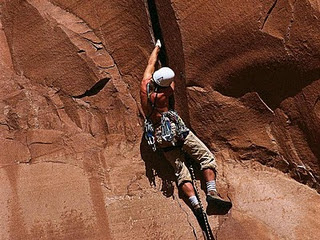
The limestone cliffs of the Gorge provide a challenge for all grades of rock climbers. The ravines are up to 700 metres deep and vary in width from 10metres of white water rapids at the narrowest point before expanding to a width of 600 metres at the widest part.It is however the spectacular scenery that attracts most visitors. With plenty of viewing spots along the narrow roads, travel can be quite slow! It is easy though to get off the beaten track and to go hiking along the dozens of trails that surround this beautiful spot.
Or if more leisurely pursuits attract, then why not hire a canoe or a paddle-boat to explore the Gorge where the turquoise of the Durance gives way to the blue of the Lac de Sainte-Croix, or perhaps just lounge on the beach beyond the Pont du Galetas!
With its ancient star hanging precariously between two guarding hills, the beautiful town of Moustiers-Sainte-Marie at the west end of the Gorge, provides the perfect place to finish the journey. Sitting in one of the heated spa pools at the Hotel Le Colombier in Moustiers and contemplating the view over the mountains is an ideal way to treat tired limbs at the end of the day - before a short walk into town and dinner!
Castellane is about 95KM north of Nice Airport and Moustiers is 120km from Marseilles. A wide range of hotels and restaurants are available in both towns.
Thursday, June 2, 2011
Adrenaline-Pumping Travel Options from Costa Rica to Beijing
Heading on vacation isn't always about lounging on the beach. For every traveler who longs for some time to relax, there are dozens of others who want something a bit more exciting. And for those adventurers, a great vacation is less about finding the best hotels in Costa Rica with places to lounge and read, and more about getting as close to the action as possible.
When it comes to adrenaline-pumping travel options, there are plenty of choices out there to satisfy spirited adventurers. And while there may be go-to spots for particular extreme sports and challenging activities, it's also possible to find adventure elsewhere. Surfing particular stretches of beach in Costa Rica can be more challenging than tackling some of the easier beaches in Hawaii. Likewise, snowboarders might find that dune-boarding in South America is easier said than done, while those used to skiing the slopes of Europe might be completely floored by a mountain in Vail or Bariloche. Sometimes, the best way to have a truly adrenaline-pumping vacation is to stick with the same area of interest, but with a change of scenery.Adventure can also mean visiting truly remarkable sights, where getting the perfect photo requires a little blood, sweat and tears. Countless hotels have popped up around volcanoes worldwide, mostly to accommodate the legions of visitors who long to hike on the sometimes-volatile slopes. These days, it's just as easy to find Arenal, Costa Rica hotels as it is to look up a Costa Rican resort package. There's definitely more interest in more extreme sightseeing from Sicily to Central America.
For that perfect combination of adventure and physical challenges with great views, sometimes the path less taken is the best choice. After snorkeling or exploring the jungle, there's nothing more perfect for a sleepy adventurer than retiring to one of the numerous Galapagos Island hotels that is focused on providing comfort without retreating from the beauty of the islands themselves. And adrenaline-pumping travel doesn't have to stop in remote corners of the world, either. Whether it's indoor skydiving or strenuous climbing walls, the world's big cities often offer other methods designed to challenge and delight visitors. Quite a few hotels in Beijing can recommend more invigorating retreats in the city, or even arrange for exploration of the lands beyond the concrete jungle.
So whether jumping out of a plane, clawing up a cliff, or simply surfing or skiing a new stretch of land, adrenaline-pumping travel options are everywhere. All that it takes is deciding on a location, and the rest of the details fall into place. For those travelers with a need for speed, it's possible to find something more active and more exciting in every city on earth.
Source:http://www.allhotels.com.sg/
Monday, January 12, 2009
Lessons Learned, Discoveries Made, and Our Adventures Along the Way
In this final post we offer our reflections on the work and experiences we had in Cappadocia. We are extremely grateful to Dr. Jones for allowing us to participate in her field research. This is a summer none of us will forget.
StephanieHard as it is, I love what I do, and working in Cappadocia confirmed that the perks of working in art history are vast. My major field of study is Modern art, so I jumped at this unique opportunity to get out of the archive and into the field. The past weeks in Cappadocia became a kind of art history methodological boot camp, primarily of iconography and style, and I was able to really hone my eye (and my calves) as we inspected every minutia of these many churches. Working directly with art objects has secured my knowledge that art history is about honoring the work that you study, and that this field begins and ends with the object.
BradThis was my third season in Cappadocia and by far the most valuable. My first two seasons correspond to my first two years of graduate school. I was naive and a newbie to art history, Byzantine studies, and fieldwork. I just assumed research in Cappadocia---side-by-side with my Professor in locked rock-cut churches-- was a given rather than an exceptional experience. I made those first two seasons about me and asked Meryamana what she could do for me. This season was entirely different. We did not set foot in Meryamana but she was ever-present. Each rock-cut church spoke to us in a variety of ways, most notably through iconography and style. With each conversation we learned more and more about Meryamana and Byzantine Cappadocia. This summer I learned about our responsibilities as art historians. We are stewards of the monuments. Our job is to listen to what they have to say and find ways to articulate the meanings that have been silenced for nearly a millennium. I felt like the work we did this summer helped us to hear, if only a whisper, what Meryamana has to say.
SarahI have acquired a variety of skills during our time in Cappadocia, including how to differentiate between tuff and ignimbrite and how to distinguish the styles of Armenian workshops from those of Constantinople. I have learned that the foundation of these skills lies in the ability to see relationships forming around you. My time in Cappadocia made me realize that the rock-cut churches continue to be intertwined with the local culture. In order to reach the churches we had to pass through modern tourist traps, trek through farms and herds of livestock, and have photo-ops with the Turkish national military. My realization that these churches are approached from a variety of perspectives – i.e. an example of cultural heritage versus a pre-fabricated pigeon coop – encouraged me to see the monuments with fresh eyes. Only then could I begin to see important possible relationships, such as the connection between the brushwork of single decorative motif and the rendering of the Theotokos’s veil by a single hand.
Our days in the field introduced me to the practicalities of conducting research in Cappadocia. Rock-cut churches are rarely on the map and asking for directions often leads to further confusion, so perseverance is absolutely required. Inside the churches I was first overwhelmed by the sheer amount of imagery that survives; with time I was able to discern smaller variations from church to church. In the evenings, tracing motifs not only resulted in the first drawings of mine that I could consider fridge-worthy, but also trained my eyes to look for the nuances of brushstrokes and technique. Knowing how to search, knowing what to look for, and knowing how to look are all tools I am very thankful I can bring back with me from Cappadocia.
Now we present to you a photomontage full of adventure and bloopers. Thank you for following us this summer. In order to prepare ourselves for our treks through the valleys, our meals always included a layer of the nutritious mineral known as volcanic tuff. Tuff is also useful as a skin salve, nose protectant, and hair styling product. We had to protect our daily rations from the encroaching local wildlife. Aside from all the tuff that we ingested we also sampled the exotic local cuisine. Airplane 'cuisine'.Entries and Exits
Getting into rock-cut churches often proved to be a challenge, and required cooperation among the group. (Lynn would like to point out--on the left pic-- that she was waiting for the guides to get their act together so that she could get down, and on with her day.) X doesn’t always mark the spot in Cappadocia, but the landscape offers clues. Road hazards and never-ending stairs became a part of life. Here at Ihlara it's 361 steps down--and 361 back up. Thankfully, aside from exhaustion and a few scraped knuckles, our injuries were limited to the infamous “church neck” and “tracing neck.”
Wizard Staffs and Wild Dogs
As we hiked through the Cappadocian valleys, we often had to arm ourselves as rumors of wild dogs circulated. Grrrrrrr. Dr. Jones protected us with her bare hands against the reptiles lurking in the grass and under stones. (Lynn would like it to be noted that she waved tortoises in the general direction of these herpetological threats, and that it seemed to work.) The local tour guides proved to be fountains of wisdom, retelling the narrative of Iconoclasm through depictions of pre-Iconoclastic chickens and Satanic grasshoppers. An important lesson learned: always befriend the people with guns, even if they are a little too friendly.
As tempting as it was, we proceeded on foot and were thus deprived of a “nice experience.” We somehow managed, and saved ourselves twenty Turkish Lira a piece.
Subscribe to:
Posts (Atom)