Showing posts with label Caving. Show all posts

Thursday, August 26, 2010

Caving

We got the email from CJ and it said, “You COULD drive all the way up here to PA, or we could meet halfway in WV, where there are some caves we could check out; though we’d likely have to invest in some headlamps/knee pads.” Which means, in all likelihood, that we will have to crawl on our bellies through tight gaps with pointy underground rocks dripping with mud or poking us in the kidneys and underground sludge oozing off every turn and we will only have one powerbar to split between the three of us for many, many hours. This is generally what CJ means when he suggests anything outdoorsy; “Let’s go climb Mt. Owen!” means you are sure to be covered in shit and hoarding power bars come turn-back time. “Let’s go rock climbing!” means we’ll be covered in shit and out of power bars by noon. “Let’s go caving!” Well, I guess you can’t say we didn’t know what to expect. We’ll appoint ourselves responsible for snacks, at least.

Joshua called to confirm: “So… Should we meet up in WV? What’s up with this caving thing anyway?”
I can’t hear CJ’s response but Joshua is very excited; he translates for me: “Some cave! … In the ground!… !!!”
Me: (from the kitchen with Jeff finishing up some dishes) “Will we have to crawl through mud on our bellies?”
Joshua: “Cheyenne wants to know if we’ll have to crawl on our bellies.”
Joshua: “He says there might be some tight spots.”
Jeff in kitchen: Snorts audibly.
Me: “I just don’t think I can crawl underground on my belly between giant boulders. Underground.”
Joshua: “Cheyenne doesn’t want any belly crawls.”
Me: “Ask him about the mud.”
Joshua: “He says, ‘what about crawling on your side?’”
Jeff: Rolls eyes back into head.
Me: “Foot, Down.”
Joshua: “So, uh, any other caves where you don’t have to belly-crawl?”

There are; one is in Pennsylvania not an hour’s drive from CJ’s house.

THE CAVE.

I had imagined something more, well, cave-entrance-like. Maybe with ferns, and a trickle of water coming down one side. A triangular, lean-to like opening made of some slabby rock covered with moss and strewn with wild thyme and honeysuckles. Something like you might see on the cover of a Hardy Boys novel. An artist’s rendition. This was not one of those caves. After picking our way down a poison ivy-infested hillside strewn with broken beer bottles the local color liked to chuck off the highway above, we arrived at large metal pipe sticking out of the ground at a 40-degree angle; it has a heavy metal door with a tiny window and it is padlocked from the inside. CJ has a key and he is intending for us to go in the pipe and to lock the door after us.

Caving(CJ has to repeat three or four times to me in plain monosyllabic English that we are to go down. “It opens up once you get down, really.”)

My outstanding caving outfit consists of sturdy hiking boots, knee pads, work gloves, light rain jacket/windbreaker, helmet, and head-lamp. I was really happy to have the pads about four feet into the chute when I nearly shear off my kneecaps on something the Above World might call a “hand-rung.” Unfortunately, installed on the bottom of the pipe, it functioned more as an impediment or perhaps tailbone cruncher depending upon whether you felt a face-first or ass-first descent was appropriate. Also the pipe is about two feet in diameter, at an awkward angle, in a decidedly downward direction, and covered in wet clay. Once you get to the bottom of the chute, there is a drop down to the cave floor of around three feet, but on my stomach with my hands locked around the former kneecap killer, I couldn’t see that and so I dangled picturesquely flailing my boots around until I smacked my foot into a rocky outcropping (yipe! bad caving etiquette!). Once out of the pipe, I look around to find that “opens up” is something of an overstatement because not only is there not sufficient space to stand, there is space for only one person at a time, and the floor is a sludge of muddy gravel continuing a steep slide down and around the corner out of sight. The not-floor parts of the cave are pointy limestone covered completely with wet clay. Also, there is a stinky dead ferret lying at my feet, which: awesome. I escape the ferret and slide down a bit to find a larger area and wait for Joshua and CJ.

After much echo-ey shuffling and swearing, Joshua meets up with me and then CJ arrives. We descend rapidly for a bit and then find ourselves in a large cavern. From here are three or four routes; CJ chooses the easiest and shortest first to get us warmed up. We creep along a bit (Hey! Caving!) and then promptly come to a belly crawl. “Just a little one!” CJ chirps and worms his way through while I look on in horror. Once on the other side he peeks back at us and gives us some cheerful pointers on how to maneuver in sticky sucking clay when you have a gigantic boulder over yourself. I go next to get it over with.

CavingI got about half way before Joshua had the bright idea to record the action with our camera. “Hold it right there for a minute while I get the camera ready.” Like hell: “I’m not stopping now!” This is about where I started to think about earthquakes and quarry blasting and torrential rainfall and all those things that one should maybe keep far from one’s mind while inching through tight crevasses. The clay sticks to you and so inching along is strangely tiring; this crevasse is maybe a little over a body length long—not bad, I’m sure—but I’m feeling a little panicky by the time I make it to the other side because now there is a belly crawl between me and the entrance.

A minute later, Joshua is inching through and CJ is scouting ahead a little; he calls back, “So uhm, I sort of forgot about this one—Cheyenne, there is another, uh, tight spot, but I think I seem to remember it’s a little shorter.”

(Oh Christ.)

It actually is a little shorter and I’m trying to not freak out now as we head on. The majority of the route consists of butt-slides and clambering because there just is not a normal “floor” anywhere in here.

Caving
Caving
Caving

Caving photos are weird in that there is no sense of reference; in this section, you emerge head first into a decline, which is mildly awkward. After a bit we come to the “Art Gallery,” a squat tunnel where dozens of people had made weird little clay snowmen and signed their names with clay-worm letters. CJ says the cave is frequented by boyscout troops, among others. Yeesh—the thought of ten kids in this cave is enough to make me hyperventilate. Also, I’m such a wuss.

We get to a section where the only way further is a hole in the floor, which would be a belly crawl in any other orientation but in this case is a rapid downward descent with only the gummy clay to keep you under control. CJ goes right down and calls up that there is a small room and it is the end of the passage. He says there might be space down there for three people and there are some cool crystals down there. Joshua picks his way down but I decline in favor of resting in a lovely stand up-able space and because someone has to guard our packs from marauding boy scouts or cave-trolls.

CavingSelf portrait of Intrepid Caver. My spirits were up exponentially at the thought of turning back.

Caving
CavingJoshua and CJ ascending back out of the “room” at the bottom of the Hole.

Returning went much more smoothly; in fact, we were back in the main room near the entrance in no time. The belly crawls didn’t bug me so much when I could put them behind me.

CavingCJ was happy to pose for Joshua on the return Belly Crawl.

We hung out a bit catching our breath and drinking some water (caving is really tiring even though we were primarily on our feet the majority of the time—you are constantly balancing and stooping and trying not to brain yourself on all the sticky-downies). I was actually feeling a bit like, “that’s it?” when it turned out it wasn’t because CJ was up and disappearing down a different branch of the cavern.

This tunnel was similar to the first but with fewer belly crawls. It also didn’t take very long to get to the bottom and back to the main cavern. The third tunnel had us hunting around for the entrance; this is because it is a 10-inch high, two foot-wide hole off the floor of the cavern. I kept repeating, “We’re going in THAT?” and “Holy crap!” but CJ was already though it and hell if I was going to get left behind with the rabid boy scouts. This was definitely the tightest squeeze and it the pointy rocks were indeed out to get the vital organs but it lasted only a few feet whereupon it opened up and went down rapidly. This section of the cave was the most interesting but also the most difficult mostly because it involved stemming across a crevasse that went down out of sight. The idea of slipping and getting wedged down there was enough to keep me in a persistent state of neurosis. I swore like a sailor with much frequency during this stretch.

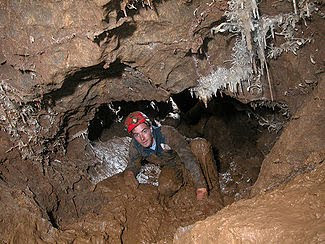
CavingIf you look carefully, you might notice an abundance of clay over our very beings.

At the bottom of the crevasse-defying stemming descent was a huge room—not so much in girth but in height because it went farther up than our flashlights could reach. Ginormous boulders dangled out of the gloom above our heads and their offspring littered the floor of the cavern. There were cool curtain-like (calcite?) formations and seams running through the rock walls. Here we had interesting discussions about such topics as how frequently those looming boulders fell and how feasible would it be to find one’s way back if all our flashlights went out. We turned off the flashlights for about two and a half seconds to marvel, albeit briefly, at the complete lack of light. Yep, dark. Time to head back now.

CavingThis looks like a belly crawl but it is not; CJ and I are heading vertically up a slimy chute, and apparently pretty goddamned happy about it too. (Note pack sitting on horizontal ledge over our heads.)

Eventually we returned to the evil little belly squeeze over pointy rocks, which on the uphill is a real gut-punching menace. Once back to the main cavern, we scrambled back upwards through the sludgy gravel to the tiny room with the dead ferret. Climbing out of the metal pipe was even more difficult than sliding down, not surprisingly, and right as we got to the top, we could look up at the sky over the rim of the pipe where there was one ginormous and ugly spider crouched about six inches over your face. Ungh god.

Outside it was about twelve billion degrees and we were covered with gunk and had on all this protective gear and we were sweating from the squeeze uphill. But wait, hold everything! We need the Intrepid Cavers Mission Completed photo.

CavingYeah, didn’t turn out so well. That’s because our camera was approximately 54 degrees and, like I mentioned, Pennsylvania was 12,0000,0000000,00,000 degrees or some insane bullshit, and the lens was all fogged.
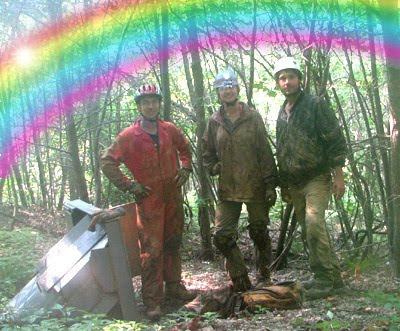
CavingHere, I photoshopped it. Bad Ass.

We backtracked up the beer-bottle strewn hillside, stripped down and chucked our muddy duds all over the street once more. Then we went out for microbrew and bar food, arguably the best part about caving.

you can source in: http://sv-timemachine.net/


Saturday, June 26, 2010

Caving

Caving—also known as spelunking by some in the United States and occasionally potholing in the United Kingdom—is the recreational pastime of exploring wild (generally non-commercial) cave systems. In contrast, speleology is the scientific study of caves and the cave environment.

The challenges of the activity depend on the cave being visited, but often include the negotiation of pitches, squeezes, and water (though actual cave diving is a separate sub-specialty undertaken only by very few cavers). Climbing or crawling is often necessary, and ropes are used extensively for safety of the negotiation of particularly steep or slippery passages.

Caving is often undertaken for the enjoyment of the outdoor activity or for physical exercise, as well as original exploration, similar to mountaineering or diving. Physical or biological science is also an important goal for some cavers. Virgin cave systems comprise some of the last unexplored regions on Earth and much effort is put into trying to locate and enter them. In well-explored regions (such as most first-world countries), the most accessible caves have already been explored, and gaining access to new caves often requires digging or diving.

Caves have been explored out of necessity (for shelter from the elements or from enemies), out of curiosity or for mystical reasons for thousands of years. However, only in the last century or two has the activity developed into a sophisticated, athletic pastime. In recent decades caving has changed considerably due to the availability of modern protective wear and equipment. It has recently come to be known as an "extreme sport" by some (though not commonly considered as such by its practitioners, who may dislike the term for its perceived connotation of disregard for safety).

Many of the skills of caving can also be used in the nature activities of mine exploration and urban exploratio

CavingCaving

Monday, June 14, 2010

Saturday, March 6, 2010

Caving

Cavingthey doing climbing in the cave

Cavingornament in the cave: stalaktit and stalakmit

Cavingornament in the cave: stalaktit

Cavingornament in the cave: stalaktit

Cavingornament in the cave: stalaktit

When caving you'll get to see sights most people never see, have a lot of fun and meet others with a similar sense of adventure. Teamwork is an essential part of caving and working together to negotiate the underground terrain is all part of the fun.

Once you're underground you might squeeze through narrow passages, walk through underground streams and visit large chambers filled with stalactites, stalagmites, waterfalls and many other wonders.


Monday, January 11, 2010

Caving Between Hobby and Science

Caving Between Hobby and ScienceCaving Between Hobby and Science

Caving or search the cave, arguably long enough is known of Indonesia. Exactly this activity has begun to bloom in the 1980s, when the Union of Speleology and Caving Indonesia (Specavina) was formed in Bogor with his characters, among others, dr. Ko King Tjoen, Norman Edwin (late), Dr. Budi Hartono, and Effendi Soleman. Start from here a new hobby activities so that time to spread, especially on campuses. This hobby in the early development seems to falter because the didalaminya not only physical skills but also the scientific aspect. In addition, the necessary equipment purchased here was difficult. Specavina, when it was also somewhat selective divide "science" to enthusiasts. Only those who have a scientific background or knowledge of Speleology love are allowed to join. Specavina as a pioneer when it accidentally further highlight scientific elements (Speleology) rather than "sports" (caving).

One aspect that must be known to fans of caving is a basic knowledge of geology. Especially how the early caves were formed, which can be found in the area, the nature of rock, kind of cave, and so forth. With this knowledge base, caver (search caves) can easily find a cave. Because, they will only go to areas that have a lot of limestone.

In theory it was true. There are many caves in the area of limestone (karst). Armed with that knowledge if you can read the same geological maps, the distribution anywhere in karst regions, where the right destination for travel on an expedition.

Another aspect that is not less important is the cave biology (biospeleologi). It does not need to be a biologist first and caving can pursue. But at least with a capital "read-read" first, search the cave can compare the flora and fauna of the caves with one another. Or maybe he's found a new specimen that can increase knowledge of biology vocabulary of the cave in Indonesia. He also became knows how to keep the collection well before being taken to an expert for identification.

Uniqueness

Spelled unique cave fauna. Overall adapt to the environment not only spelled out the eternal darkness tens or hundreds, but thousands of years. They adjusted to the natural evolution of darkness. In a cave in America ever found transparent and no-eyed salamander (eyeless), even blind (blind). Salamanders were allegedly trapped in a cave and not get out.
To survive animals had developed a sense of touch and perasanya such a way to replace the function of the eye. Over time the lining of sight to it was closed because of redundant.
So even in a cave flora adapt to the environment of total darkness. Plants need to live on the surface of the sun. Leaved plants have not been reported found in the cave. Commonly found are various fungi that looks weird. For example there is a fungus that has a long neck, with small caps but limp.

In Indonesia, the discovery of cave animals are spelled sensational ever happens. But unfortunately it was not recorded in official government or international agencies. In the 1980s, exactly how many years already. Forget, the club cave Garbhabhumi surfer from Jakarta when a total solar eclipse, go to the Cave Ngerong in Tuban, East Java. Shape of the cave is a cave which is the river water.

Norman led the club Edwin (late) then barged in and against the flow of rubber boats. Less than a kilometer, they hit the waterfall. After climbing the waterfall, they step across the top halted because there were springs. The corridor could be traced back further, but it requires diving techniques and equipment. When it was decided to stop and go back outside.

In part this is why they are not intentionally seen flickering in the water bouncing off the lights. It turns out that shiny stuff that is fish. After dipelototin closer, the fish-eyed and not transparent.

Wrapped with a sense of delight, the specimen was taken to Jakarta to be identified. Several months tawes fish-like child was still alive in the aquarium as in the natural conditioned by Riza Marlon (now a professional photographer).

By Yatna Supriatna, now a doctoral biology, the findings were identified as Puntius microps. As a comparison, eyeless animals in a cave in America or Europe are found at depths of tens to hundreds of pounds. But in Tuban, less than two kilometers. Maybe this could be our study materials scientists interested in cave biology. If there were, I could give birth to hundreds of doctors, why can not here? Scared gelapkah, muddy and mystical shadows of the cave that lead to people reluctant to deal with it?

Cave Mapping

Sign in caves did not just come in and admire the beauty in it alone. However much to be done. Especially when times were not many clubs that cave surfer to claim the prize must be proved with maps and photographs. Accuracy of the maps seen from a cave who makes them. Unfortunately, pride and passion to make a map of the cave by caving clubs in Indonesia, sluggish.

This differs from the condition of the cave in search clubs abroad. They are so keen to compile a map a cave until the details. Until finally created special symbols in a meticulous mapping of the cave. If there is a special case is found, such as speleothems (cave formations like stalactites, stalagmite, gourdam, straws, cave pearls, etc.) that may be a special form, usually with a slice of the map was created detailed drawings or symbols. On the map is usually listed grade, the higher the grade number were listed in the more accurate the map was created.

There are delicious the next generation. If you wish to enter the cave to stay in with a guide map. But there is not just a search following the instructions on the map.

When plans are made before there was an error will be corrected and reported to search caves community. So not surprisingly, is now almost certain to map caves in developed countries, accurate. All cave was mapped, followed by a complete data base.

I was so full, they can know where the cave is the longest or deepest in the world. Deepest caves and until now his record is unbroken Voronja Cave in Georgia, fractional former Soviet Union, namely 1710 meters.

Imagine how long to descend the rope that is used and how long does it take to reach the bottom of the cave. While the longest cave and tunnel complexes all-aisle is Mammoth Cave in the United States namely, 563.270 km and depth of -116 m. More details please click www-sop.inria.fr/agos-sophia/sis/DB/database.html. Here is a little cave on the Indonesian data.

The news that the mapping of the cave was once walking in Indonesia, it's understandable. Because fans tend to like caving here in terms of sports and adventure. Scientific aspects rather unattractive, but did not master. Biologist or geologist true in Indonesia, is there anything that builds the thesis of the cave? Even if there might not amount to a count of fingers of one hand.

World target

The potential caves in this country really is not less attractive to those overseas. When in the 1980s, this area became the target of the world caver. Various ways they can do for caving in here, but that mention knock regulation of foreign researchers have permission LIPI. The existence of that rule is actually a good thing. They were not arbitrarily "explore" the cave in Indonesia. Unfortunately, that opportunity was not used by us to search the cave itself as the first.

Later, a geologist who is also a British caver, Tony Waltham, entered through the path of a department. He supposedly came to help irrigation in the arid area of Gunung Kidul.
As a geologist, he knew very well that the water there was only found in the river underground alias in the caves. He also understood that the karstic area of Gunung Kidul is the postscript is a nest cave that has not fiddle with the caver diutak anywhere. Upon their return from Indonesia was not long before the book was published about the caves there, following a captivating photographs.

The potential caves are still promising, according to geological maps are located in Sulawesi and Papua. But the challenge is that in Papua. In addition to the written map karstnya wide area, as well as "thickness" to thousands of meters. That is, if there is a vertical cave (pothole) at the depth of the potential to beat Papua Voronja Cave in Georgia!

Wednesday, July 1, 2009

See Cave

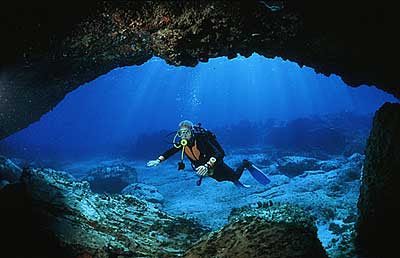
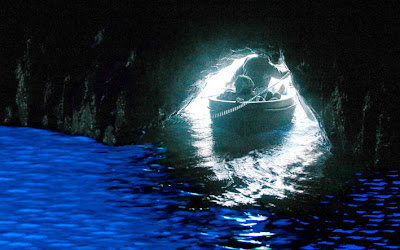
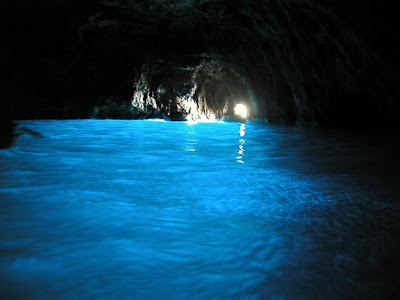
Sea caves are erosional caves, formed by the action of waves against rock, usually along an existing fault. The Blue Grotto of Capri is a popular and photogenic cave due to the appearance of light from the bottom of the cave. Sunlight enters the cave through underwater channels and reflects off the limestone floor. More types of caves, after the jump.

See Cave
See Cave
See Cave
See Cave
See Cave See Cave